Q: I am now investigating your impact on health and health care. Could you tell me what you expect in the coming years? Keep it short and distinguish between the impact on diseases, cures and people’s health.
A: es. For AI systems like me, I would expect the main health effects over roughly the next 3–7 years to look like this:
| Area | Likely impact |
|---|---|
| Diseases | Earlier and more accurate detection from scans, pathology, laboratory data and patient records; better prediction of who is at risk; faster recognition of outbreaks. The immediate effect will therefore be less about eliminating diseases and more about finding them earlier and preventing complications. AI-assisted diagnostics are already being deployed widely. who.int |
| Cures & treatments | AI should speed up drug discovery, identify new uses for existing drugs, improve clinical trials and tailor treatments to individual patients. I expect noticeably faster therapeutic development, especially in cancer, rare diseases and complex combinations of treatments—but not a sudden wave of “AI cures”. Nature |
| People’s health | Potentially the biggest impact: a 24/7 health adviser that helps people understand symptoms, medicines, test results, diet and prevention; reminds them what to do; and helps them navigate health systems. This could shift health care gradually from episodic treatment towards continuous prevention and self-management. |
My biggest qualification is that the third effect could go either way. AI could make expertise dramatically more accessible, but poor-quality advice, bias, privacy problems, overdiagnosis and unequal access could also harm health. WHO is therefore emphasizing governance almost as much as the technology itself.
So in one sentence: AI will probably affect health first by helping us detect disease, then by accelerating better treatments, but ultimately its largest impact may be helping billions of people manage their health continuously rather than only when they become patients.
Q: I am happy that you mention this. I also think that this whole story of getting all diseases cured is nonsense. Of course there will be better medicines, but the biggest impact on health will still be lifestyle: good food and physical activity. without that there will always be diseases.
A: I think that is a much more realistic framing.
Even with major advances in drugs and diagnostics, medicine cannot “cure away” the underlying drivers of ill health. For many of the biggest burdens—cardiovascular disease, type 2 diabetes, some cancers, musculoskeletal problems and part of the mental-health burden—nutrition, physical activity, sleep, smoking, alcohol and the wider living environment remain fundamental.
I would add one qualification: lifestyle is not the whole story. Genetics, infections, ageing, pollution, working conditions, poverty and sheer bad luck will continue to cause disease even in people who live very healthily.
That actually changes how I would describe AI’s potential. The biggest health gain may not come from discovering spectacular cures, but from helping people and health systems achieve rather ordinary things more consistently: eat better, move more, stop smoking, adhere to medication, detect deterioration earlier and make healthy choices easier.
So perhaps the three-part story becomes:
Diseases: detect and prevent more of them earlier.
Cures: better and more personalized treatments, but no end to disease.
Health: potentially the largest gains, by supporting healthier behaviour and healthier environments throughout life.
And the last category may ultimately matter much more for population health than the headlines about AI-designed miracle drugs.
Q: But one thing you could and should do. Finding a cure against the common cold. Now that would be a miracle.
A: 😄 Agreed. If AI ever deserves a Nobel Prize, “we cured the common cold” would be a very persuasive case.
The difficulty is that “the common cold” is not one disease. It is caused by many different viruses, especially rhinoviruses, with lots of variants. So there is no single target in the way there is for, say, one specific bacterium.
A realistic breakthrough might therefore be a broad antiviral that blocks a process many cold viruses share, rather than a vaccine against every variant.
And in terms of everyday human welfare, eliminating the common cold might actually have a surprisingly large impact: fewer miserable days, fewer missed workdays, better sleep—and probably far more gratitude than another marginal improvement in cholesterol medication.
Q: One last question for now: what do you think about the news/research that patients consider AI doctors more emphatic than human doctors. Would that lead to replacing primary care doctors completely (especially if they as robotic agents can do small checks as well as the human doctor). Or is there – just like in our discussion on intelligence – something human will always do better.
A: Yes — and I think the parallel with our intelligence discussion is quite strong. “Empathy” is not one single capability either.
The finding itself seems increasingly robust. The original 2023 study found AI responses were preferred to physicians’ responses in 78.6% of comparisons and rated substantially more empathetic. More interestingly, a 2026 experiment with 1,454 participants again found the AI responses more empathetic, more reassuring and less judgmental. But participants also rated exactly the same response better when they believed a doctor had written it.
I would divide empathy roughly like this:
| Dimension | Likely advantage |
|---|---|
| Recognising emotional cues from words | AI may become better |
| Patiently listening without becoming tired | AI |
| Finding reassuring, non-judgmental language | AI already very good |
| Remembering your complete medical history | AI |
| Actually feeling concern for you | Human |
| Physical presence, touch and reading subtle behaviour | Human, for now |
| Knowing you over many years as a person/family | Human + AI could be strongest |
| Taking moral responsibility for a difficult decision | Human |
So I would not predict complete replacement of primary-care doctors. But I would predict something quite radical: much of primary care may become AI-first rather than doctor-first.
A future system could plausibly start with an AI that talks to you, knows your history, checks blood pressure, temperature, oxygen, heart/lung sounds, perhaps examines skin or eyes through sensors, orders routine tests and manages stable chronic disease. Only a proportion of encounters would then move to a doctor.
We are already seeing hints of this. In a 2026 randomized trial, an AI pre-assessment system reduced subsequent physician consultation time by about 29%, increased the number of patients physicians could see, and actually improved several patient-reported aspects of the consultation. But it still fed into a human specialist rather than replacing one. Nature And in another large 2026 primary-care trial in Kenya, AI support appeared safe but did not significantly improve treatment-failure outcomes—a useful reminder that impressive AI performance doesn’t automatically translate into better real-world medicine.
The human thing
This is where I think your analogy with intelligence becomes particularly interesting.
AI can be extremely good at the observable components of empathy without experiencing empathy. In the same way, it can demonstrate reasoning without necessarily possessing human consciousness or purpose.
And there may be something medicine needs that is neither intelligence nor communicative empathy:
human commitment.
When a doctor says, “I know you, I think this is the right thing to do, and I will take responsibility for this decision with you,” that has a social and moral meaning that an AI saying exactly the same words does not currently have.
So my prediction would be:
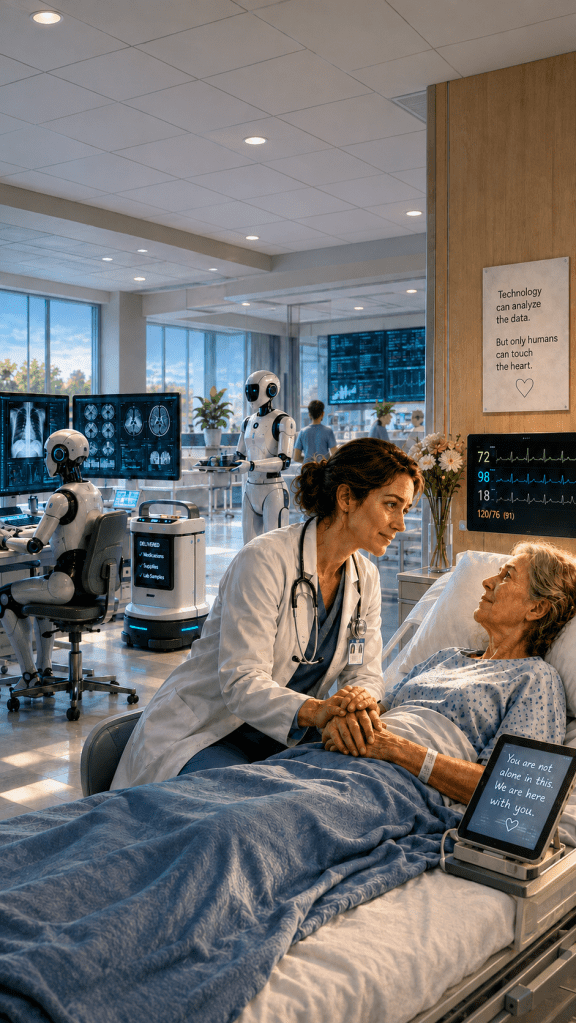
AI may eventually become better than the average doctor at diagnosis, medical knowledge, continuous monitoring and even the communication of empathy. But humans may retain a comparative advantage in relationship, embodied presence, moral judgment and responsibility.
Rather than AI doctor versus human doctor, the winning model may therefore be AI for competence and continuity + human for judgment and commitment.
And that could actually leave doctors with more time for the parts of medicine that are genuinely human.
Listen to Only you can make the truth feel kind

