
Q: describe briefly what you think are different components of intelligence and make a table with these components and assess the relative advantage or score of AI versus humans on this component
A: The result is in the picture below.
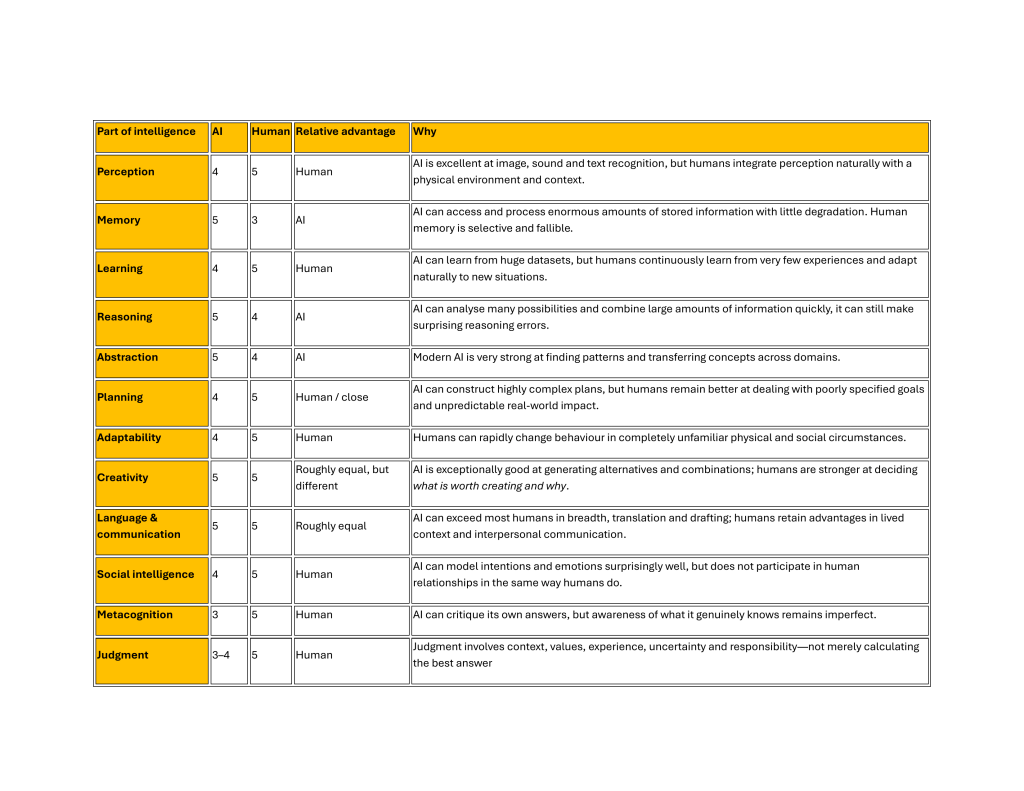
Put simply, this gives as strongest advantages:
𝗔𝗜: memory → reasoning → abstraction → information processing → language
𝗛𝘂𝗺𝗮𝗻𝘀: judgment → adaptability → metacognition → social intelligence → real-world learning
Moreover, intelligence itself does not tell us what an intelligent system wants. A system could score 5/5 across every dimension of intelligence and still have virtually no intrinsic purpose of its own. This may be one of the most fundamental differences between biological intelligence and present-day AI.
This brings me to two hypotheses that I think deserve more attention:
𝗛𝘆𝗽𝗼𝘁𝗵𝗲𝘀𝗶𝘀 𝟭: Intelligence has multiple dimensions. In some of these, humans still outperform AI; in others, humans bring a fundamentally different perspective. Saying that AI is simply “more intelligent” than humans is therefore an oversimplification.
𝗛𝘆𝗽𝗼𝘁𝗵𝗲𝘀𝗶𝘀 𝟮: Even if AI surpasses humans across many dimensions of intelligence, this does not necessarily imply dominance over humanity. Intelligence alone does not create ambition: if AI has little intrinsic purpose, desire for control, or need for social connection, superior intelligence may not translate into a drive to dominate.
I’d be very interested to hear your thoughts: agree, disagree, or somewhere in between? Let me know in the comments.

