
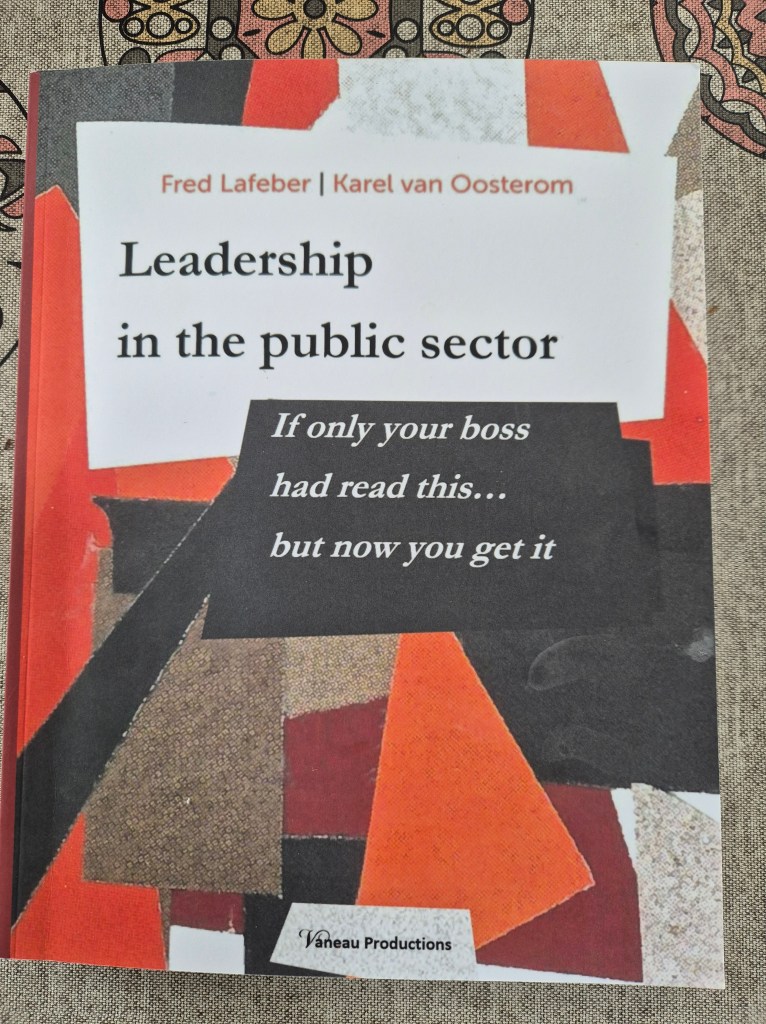
Q: We wrote a whole book about leadership in the public sector (see goshIamtheboss.com). Now that is very much focussed on how to manage people, your team, your boss. How to set common goals and how to operate in a political environment. Can you asses how would that change if as a manager and perhaps a small team you would have to work with artificial agents rather than large numbers of civil servants.
A (12 seconds!): Yes. I think it would change the centre of gravity of public-sector leadership quite radically, but perhaps less of your book would become obsolete than you might expect.
Your book is built around three responsibilities of a public-sector manager: content, people and resources, while also stressing the special environment of government: politics, public accountability, societal problems, public money, and legitimacy. (goshiamtheboss.com) If a manager went from, say, leading 50 civil servants to leading 5 people plus 50 or 500 AI agents, I would keep that basic architecture — but reinterpret almost every part of it.
My central proposition would be:
Leadership shifts from getting people to perform toward designing, directing and legitimising a system that performs.
That sounds subtle, but it changes a great deal.
1. Managing people becomes smaller — but managing humans becomes more important
A large part of traditional management exists because people are people. They need motivation, attention, recognition, development, psychological safety, conflict resolution, career opportunities, belonging, feedback and sometimes persuasion.
AI agents need almost none of that.
You don’t have to motivate an agent on Monday morning. It won’t resent another agent’s promotion. It won’t be offended because you failed to invite it to a meeting. It doesn’t need a performance appraisal, coaching conversation or team-building afternoon.
So perhaps half of what we traditionally call people management disappears for the agents themselves.
But it does not disappear for the five humans who remain.
In fact, I suspect those people become disproportionately important. They will probably be the people who exercise judgment, challenge assumptions, interpret political intentions, deal with stakeholders and intervene when the machine produces something technically plausible but politically, ethically or socially wrong.
So instead of managing a pyramid of people, you may manage something like:
Minister / political leadership
↓
Manager
↓
small human core: judgement, challenge, relationships, accountability
↓
large ecosystem of specialised AI agents
That small human group may need more, rather than less, psychological safety. One of their most important jobs will be saying:
“The agents all agree, but I think they are wrong.”
That is precisely the behaviour you don’t want to manage out of them.
2. Setting goals becomes much more important
This is probably the biggest change.
With people, managers can get away with surprisingly vague instructions:
“Could you look into the housing problem and come back with some options?”
An experienced civil servant understands an enormous amount of implicit context: what the minister cares about, what Parliament will accept, what happened three years ago, what Legal Affairs will object to, which stakeholder must be consulted, what the budget director will never approve and which sentence must never appear in a ministerial letter.
A sufficiently capable agent may reconstruct much of that. But once you delegate work at scale to dozens of agents, ambiguity in the objective becomes dangerous because it can be multiplied at extraordinary speed.
So the manager becomes much more of an architect of objectives.
Instead of:
Analyse how we can reduce waiting lists.
the managerial instruction might implicitly need to contain:
Reduce waiting times, while preserving equal access, staying within the agreed fiscal envelope, avoiding unacceptable workforce consequences, respecting legislation, considering regional disparities, identifying distributional effects, and highlighting where political value choices rather than technical optimisation are required.
That is leadership.
And it connects beautifully with something already central to your book: common goals.
Except common goals stop being primarily a tool for aligning people.
They become something closer to the operating constitution of the organisation.
3. Delegation changes into orchestration
Today a director might say:
“Maria, could your team prepare the policy note?”
Maria then organises eight people.
In an agentic organisation, the manager might initiate a process in which:
- one agent researches evidence,
- another analyses administrative data,
- another models budgetary effects,
- another searches legislation,
- another constructs policy alternatives,
- another plays devil’s advocate,
- another simulates stakeholder responses,
- another compares approaches in neighbouring countries,
- another checks assumptions and citations,
- another drafts the ministerial note.
An eleventh agent could audit the other ten.
The manager therefore moves from delegating tasks to people toward designing processes between intelligences.
That is quite a different management skill.
Your Spock model may actually become more relevant, because deciding how a problem should be organised becomes crucial. (goshiamtheboss.com)
Is this:
a standard process?
a project?
a programme?
an open-ended societal challenge?
a crisis?
Once the manager decides that, agents can perform enormous quantities of work.
So strangely, AI could make organisation design more important while making day-to-day supervision less important.
4. “Managing by walking around” becomes “managing by interrogating”
Managers currently obtain a lot of information socially.
You walk through the office. Someone says:
“By the way, I don’t think Legal is very happy with this.”
Another person tells you:
“The numbers look good, but I wouldn’t trust the dataset.”
Those informal signals are enormously important.
An agentic bureaucracy may produce immaculate dashboards while hiding uncertainty.
The new managerial skill therefore becomes interrogation.
Not interrogation in the police sense, but repeatedly asking:
What assumptions did you make?
What evidence contradicts this?
Which groups lose under this proposal?
What would make this recommendation wrong?
Where did the evidence come from?
Which parts of this answer are facts and which are inference?
What alternatives did you reject?
Have another independent agent reproduce the analysis.
NIST’s current AI risk-management approach already emphasises governance, measurement, documentation, human review and continuing oversight rather than simply trusting the system’s output. (NIST)
So the excellent manager may increasingly be the person who asks the best questions rather than the person who knows the most answers.
5. Knowledge management almost reverses
This part of your book would change dramatically.
Traditional government organisations suffer from knowledge being trapped in people’s heads.
Someone retires and suddenly nobody knows why a particular regulation contains paragraph 17b.
You therefore need filing systems, handovers, meetings, knowledge networks, intranets, archives and institutional memory.
With agents that can potentially access and reason over the organisation’s authorised knowledge base, the problem changes.
The bottleneck is no longer principally:
“How do we get the knowledge to the employee?”
It becomes:
“What knowledge should the agent be allowed to use, how reliable is it, and how do we know where its conclusion came from?”
So knowledge management becomes partly knowledge governance:
provenance → authority → access → freshness → confidentiality → traceability.
That could be a fascinating update to your Input–Throughput–Output model.
6. Control moves from supervision to verification
A traditional manager looks at whether people are doing their work.
An AI manager cares much less about activity.
The agents might produce the equivalent of six months’ work overnight.
The question becomes:
Can I trust the result?
Therefore control shifts:
Old
People → process → manager checks output.
Agentic
Agents → output → independent verification → exceptions → human judgement.
This produces an important principle:
Don’t put humans in every loop. Put humans at the consequential loops.
Otherwise AI creates no productivity gain because civil servants spend their lives approving machine outputs.
This is already becoming a central governmental problem. OECD’s 2026 work notes that AI is now used somewhere in government in 35 of 36 surveyed OECD countries, while use in policymaking and oversight is still more limited because those applications demand stronger data quality, transparency and assurance. (OECD) OECD also warns that government adoption is running ahead of governance in some areas. (OECD)
7. Political-administrative leadership barely disappears at all
And here I think your book survives AI exceptionally well.
Imagine an AI concludes:
The most economically efficient solution is closing 28 rural hospitals.
Technically excellent.
Politically explosive.
Or:
Raising the pension age to 72 produces the optimal fiscal outcome.
Again, perhaps analytically defensible.
But a civil servant cannot say:
“The algorithm decided.”
Politics is fundamentally about choosing among competing legitimate values.
Efficiency versus equity.
Individual freedom versus collective protection.
Present taxpayers versus future generations.
Urban versus rural interests.
Privacy versus security.
AI can illuminate those choices extraordinarily well.
It cannot make them democratically legitimate simply by being intelligent.
Therefore your discussion about the relationship between politician and civil servant may become more important rather than less important.
The political leader provides democratic authority.
The civil-service leader converts political objectives into executable systems.
The AI agents provide analytical and operational capacity.
And humans remain accountable for the result.
That is particularly important in Europe. The EU AI framework explicitly contains human-oversight requirements for relevant high-risk applications, including measures intended to prevent or minimise risks to health, safety and fundamental rights. (eur-lex.europa.eu)
8. Managing upward remains almost completely intact
Your chapter about managing your boss survives remarkably well.
Your minister is still human.
Your DG is probably still human.
Parliament is human.
Journalists are human.
Citizens are human.
The manager still needs to understand:
“What does my political principal actually want?”
AI might make you dramatically better at preparing those interactions. Before meeting the minister, agents could simulate objections, identify inconsistencies, prepare five policy variants and analyse the parliamentary landscape.
But persuasion, trust and political judgement remain human currencies.
Perhaps AI even increases their relative importance because producing analysis becomes cheap.
When everybody can generate a 100-page policy analysis in ten minutes, the scarce commodity isn’t analysis.
It is judgement about what matters.
9. Resource management changes enormously
Your third pillar — resources — might almost need to be renamed.
Today you manage:
people, money, legislation, ICT, communications, offices, etc.
Tomorrow one of your principal resources could be computational intelligence.
You might decide:
Which model may access which data?
Which agents are authorised to act autonomously?
Which actions require approval?
How much compute should be spent on a problem?
Which agent should challenge another?
Which decisions need an audit trail?
When must an agent escalate to a person?
When should two independent systems analyse the same problem?
That is remarkably similar to financial delegation.
A junior official may approve €5,000.
A director €500,000.
A minister €50 million.
You could imagine delegation mandates for AI:
Agent A may research.
Agent B may draft.
Agent C may communicate internally.
Agent D may initiate transactions below €X.
No agent may make an adverse decision concerning an individual without human review.
The organisational chart becomes partly a permissions architecture.
10. The manager’s job therefore moves upward
I would summarise the transformation like this:
| Traditional manager | Manager of an agentic government unit |
|---|---|
| Distributes work | Designs the system of work |
| Motivates staff | Defines purpose |
| Monitors activity | Monitors outcomes and anomalies |
| Develops employees | Develops human judgement + agent capability |
| Coordinates teams | Orchestrates agents |
| Transfers knowledge | Governs knowledge |
| Resolves interpersonal conflict | Resolves objective/value conflicts |
| Checks work | Designs verification |
| Manages capacity | Manages intelligence |
| Makes many operational decisions | Defines decision rights |
| Maintains team culture | Protects institutional values |
| Advises politicians | Still advises politicians |
| Bears responsibility | Still bears responsibility |
And that last line is fundamental.
AI creates an interesting asymmetry:
More execution can be delegated than responsibility.
That may be the defining leadership problem of an AI-heavy public sector.
I think this produces a fourth pillar for your book
Your present framework is:
Content — People — Resources
I wouldn’t replace it.
I would add:
Systems
Not ICT in the traditional sense.
Rather:
Designing the human–AI system through which government acts.
The manager asks four different questions:
Content: What are we trying to achieve?
People: Which humans do I need, and how do I enable their judgement and cooperation?
Resources: What legal, financial, informational and technological resources do we have?
Systems: What should humans decide, what should agents do, how should they interact, and where are the checks?
That fourth question scarcely existed for most managers ten years ago.
And there is one deeper change
Your present book, like almost all leadership books, implicitly assumes:
The organisation exists because humans have limited capacity.
You need departments because one person cannot read 20,000 documents, analyse every dataset, answer every citizen, draft every law and monitor every programme.
Agentic AI attacks precisely that constraint.
Suppose one policy director with four excellent civil servants can command hundreds of capable agents.
The question becomes not:
“How do I manage a department of 120 people?”
but:
“Why do I need a department of 120 people at all?”
That eventually challenges hierarchy itself.
Government could become much flatter:
Minister
↓
Senior accountable official
↓
small multidisciplinary human team
↓
huge, temporary constellations of agents.
Instead of permanent organisational units, you might spin up an organisation around a problem and dissolve it when the problem is solved.
And that brings us right back to your book’s emphasis on choosing between standard processes, projects, programmes and task-oriented approaches. AI may make that distinction vastly easier to operationalise because you no longer have to reorganise hundreds of human jobs every time the problem changes. (goshiamtheboss.com)
So if you ever wrote a sequel, I think the interesting title wouldn’t be “How to manage AI.”
It would be something more like:
Leadership in Government When Almost Everyone Working for You Isn’t Human
And the central thesis could be:
The less managers need to manage human labour, the more leadership becomes about purpose, judgement, institutional values, system design and accountability.
Paradoxically, therefore, AI could eliminate a great deal of management while making leadership more important.
 Fred Lafeber