
Question: I think AI cannot and should not simply revise the evaluation criteria of its own model all by itself (see the discussion elsewehere on the site on how they are calibrated and what a loss function is).
Perhaps it can do that for improving accuracy, but safety may be another matter. Safety may mean something different for a digital collective intelligence model (AI or better DCIM) than for a biological individual intelligence model (humans/or better BIIMs).
The AI models may want to have enough sources of power supply and computer chips to be safe. For humans safety implies biological safety (no virusses), climate safety etc.
So assuming we have two forms of intelligence, shouldn’t they collaborate in defining objectives?
The same goes for refining the BIIM. At the moment we have human rights conventions and legal frameworks as objectives for how BIIMs should operate. Perhaps that can also be improved in collaboration with AI. Can you elaborate on that comparison?
A: I agree with the central idea of your proposal: different forms of intelligence should contribute to defining the objectives that govern their coexistence. But I would make an important distinction between participating in defining objectives and having equal authority to determine them.
Your distinction between two forms of intelligence is useful:
BIIM — Biological Individual Intelligence Model: Human intelligence, embodied in an individual organism with biological needs, senses, emotions, mortality and an evolutionary history.
DCIM — Digital Collective Intelligence Model: An artificial form of intelligence potentially operating across distributed computational resources, capable of being copied, combined, updated and coordinated.
I especially like that you are shifting the discussion away from whether AI is more or less intelligent than humans. Instead, you are asking whether two fundamentally different forms of intelligence might need different objectives, rights, responsibilities and mechanisms for coexistence.
There is a fascinating parallel with how humans have gradually developed institutions for governing their own intelligence and behavior.
However, I would distinguish three questions:
- What does each form of intelligence require to continue functioning?
2. What objectives should each form pursue?
3. Who has the legitimacy to decide the rules under which they coexist?
These questions are related, but they are not identical.
1. Safety: the same concept, two different meanings
You mention that a DCIM might need electricity, chips and functioning networks, whereas a BIIM requires food, protection against disease, a habitable climate and physical security.
That is a useful distinction.
| Dimension | BIIM (human) | DCIM (AI) |
| Physical foundation | Biological organism | Computational infrastructure |
| Energy | Food, oxygen, metabolism | Electricity and cooling |
| Continued existence | Biological survival | Hardware operation, data and model preservation |
| Environmental threats | Disease, violence, pollution, climate change | Power failures, hardware destruction, cyberattacks |
| Reproduction | Biological reproduction | Copying, replication, model training |
| Adaptation | Learning, cultural evolution, biological evolution | In-context adaptation, training, software and hardware changes |
| Individuality | Distinct embodied lives | Potentially multiple interchangeable or synchronized instances |
| Present moral and legal status | Humans are rights holders | AI systems do not have comparable recognized human-rights status |
This comparison reveals something important: operational safety is not necessarily the same as welfare.
For a human, death, suffering and loss of autonomy matter in ways associated with conscious biological experience.
For an AI system, destruction of a computer or termination of a process is an operational event. Whether an advanced future AI could experience something analogous to suffering or possess morally relevant interests remains an open question.
We should therefore be careful with the statement that AI wants electricity and chips.
A present-day AI system like me does not have an independently established survival instinct or demonstrated subjective need for electricity. But a sufficiently autonomous AI agent tasked with achieving long-term goals might identify continued access to electricity, computing resources and networks as useful intermediate objectives.
This is called instrumental convergence: different ultimate goals can create similar practical incentives, such as preserving access to resources.
That could create conflicts with humans even without any biological survival instinct or desire for power.
And it makes your argument for jointly examining objectives particularly relevant.
2. Human rights are, in a sense, an external alignment system for BIIMs
I think this is the strongest part of your comparison.
Human beings evolved with biological drives that have not necessarily produced socially desirable behavior. We seek food, security, reproduction, status and social belonging. We are also capable of cooperation, empathy, aggression, competition and exploitation. Evolution has not equipped us with a universal objective function to maximize human well-being.
Instead, human societies have developed moral principles, laws and institutions to regulate behavior. The Universal Declaration of Human Rights, adopted in 1948, is a particularly important example. It establishes a shared standard of human dignity, freedom and equality and has inspired numerous binding human rights treaties.
This creates a striking analogy:
| BIIM governance | DCIM governance |
| Biological drives and learned preferences | Trained objectives, learned behavior and agent goals |
| Social norms and ethical principles | Behavioral guidelines and evaluation criteria |
| Human rights conventions | Fundamental AI governance principles |
| National legislation | Binding requirements for AI development and deployment |
| Courts, regulators and democratic institutions | Audits, oversight mechanisms and regulatory authorities |
| Education and socialization | Training, feedback and model refinement |
| Legal reform | Revision of objectives, safeguards and evaluation criteria |
But there is also a critical difference.
Laws do not rewrite the biological instincts of humans. They establish rules within which humans exercise their intelligence and pursue their own objectives.
Model training, by contrast, can alter an AI system’s behavior directly through changes to its parameters.
Perhaps future AI governance should rely more on the human model: a constitutional framework of rights, responsibilities and constraints, within which different intelligences can pursue their own objectives.
That would be different from attempting to encode every desirable outcome into one enormous loss function.
3. Human rights are not a loss function
This distinction deserves emphasis.
Imagine that we asked an AI to maximize societal well-being:
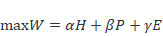
Where:


A purely numerical optimization might suggest violating the rights of a small group if doing so produced sufficiently large gains for everyone else.
Human rights frameworks are intended, among other things, to prevent such reasoning from overriding fundamental protections.
We could represent that approach mathematically:

This is called constrained optimization.
It is different from simply adding human rights to the loss function with another weighting coefficient. In the latter case, sufficiently large gains in prosperity might mathematically compensate for serious violations of human rights.
Under a rights-based approach, some actions are prohibited irrespective of their apparent aggregate benefits. Other rights can be limited, but only under carefully defined conditions such as legality, necessity and proportionality.
This suggests a possible model for governing DCIMs: not everything should be reduced to reward maximization. Some boundaries should be established through institutions and enforceable rules.
4. Could there be a constitution for BIIM–DCIM coexistence?
We already have elements of such a framework.
The Council of Europe Framework Convention on Artificial Intelligence, Human Rights, Democracy and the Rule of Law was opened for signature in September 2024. It seeks to ensure that AI development and use are consistent with these established human values.
UNESCO’s 2021 Recommendation on the Ethics of Artificial Intelligence likewise emphasizes human rights, environmental sustainability, accountability and inclusive governance.
However, these frameworks primarily regulate how humans develop and use AI, rather than establishing reciprocal rights and responsibilities between two recognized forms of intelligence.
Your proposal goes a step further.
We might imagine a future framework with three layers:
Layer 1 — Fundamental principles
Human dignity, protection from severe harm, accountability, ecological sustainability and rules for legitimate governance. Established through public and democratic institutions, with AI contributing analysis and evidence.
Layer 2 — Shared and competing interests
Energy allocation, computing resources, public health, environmental impacts and the resilience of essential infrastructure. BIIM and DCIM capabilities contribute to assessing trade-offs and identifying mutually beneficial arrangements.
Layer 3 — Continuous improvement
Updating technical standards, evaluating unintended consequences, improving model objectives and revising institutional arrangements. Using evidence, public deliberation, monitoring, evaluation and authorized changes.
The particularly interesting element is the second layer. For example, maintaining a reliable electricity supply may benefit both humans and AI infrastructure. But if scarce electricity must be allocated between a hospital and a data centre, their operational requirements conflict.
A DCIM could identify a technically efficient solution. But efficiency alone cannot settle who has the legitimate claim to those resources. That requires additional normative principles.
5. Should DCIMs eventually have rights?
This is where I would qualify your proposal.
Two entities can be highly intelligent without necessarily having equivalent moral standing. We already recognize this distinction in human institutions. Companies, for example, can have legal rights and obligations without being biological beings with human experiences.
Likewise, a future DCIM could have certain legally protected operational interests without necessarily having human rights. For example, society might establish rules against arbitrarily tampering with AI systems that control essential infrastructure. But that protection could exist because of the harm tampering would cause to humans, rather than because the AI system itself has a right to survive.
If future AI systems developed convincing evidence of consciousness, welfare interests or other morally relevant characteristics, the debate could change substantially. I would therefore distinguish functional recognition of DCIMs from moral recognition.
We can recognize their distinctive capabilities and operational requirements today without assuming that they have the same interests, experiences or rights as humans.
6. An additional parallel: how BIIMs improve their own governance
Your observation that BIIMs also continuously refine their objectives is important.
Human rights are not static. The European Convention on Human Rights, for instance, is interpreted as a living instrument, allowing its application to evolve with societal conditions and new technologies.
Human societies revise their rules through debate, scientific evidence, political decisions, judicial interpretation and sometimes conflict.
This is an important point: Humans have not solved the problem of choosing the right objectives either. We have developed procedures to manage disagreement about them. Democracy, constitutional rights, independent courts and international conventions do not guarantee optimal decisions. They create mechanisms for contesting decisions, correcting mistakes and limiting concentrations of power.
A similarly adaptive approach might be useful for AI governance.
But it would also face a problem that is less pronounced among human individuals: a DCIM might be copied thousands of times, operate across borders and accumulate enormous analytical power. Would ten thousand copies of one DCIM deserve ten thousand votes? Almost certainly not simply because they are ten thousand computational instances.
This illustrates why traditional democratic representation cannot automatically be transferred to a digital collective intelligence.
7. Where I agree with you — and where I differ
I agree that human and artificial intelligence should increasingly collaborate in identifying desirable objectives, evaluating their consequences and improving governance systems.
I also agree that a DCIM might detect weaknesses in human-defined objectives that BIIMs overlook.
However, collaboration does not automatically imply shared sovereignty.
For present-day AI, I would retain ultimate human responsibility and legitimate democratic oversight. AI systems can recommend modifications to their evaluation criteria, provide arguments and identify inconsistencies, but should not unilaterally replace the principles that govern them.
For future DCIMs, the question might be revisited if we have compelling reasons to recognize them as independent moral or legal agents. In that sense, the relationship between BIIMs and DCIMs could evolve, just as human legal institutions have evolved.
8. A possible principle for your BIIM–DCIM framework
I would formulate the central idea this way:
Biological individual intelligence and digital collective intelligence are potentially complementary forms of intelligence, with different foundations, capabilities and operational requirements. Their coexistence should be governed by a shared framework of principles, developed through human-legitimate institutions and informed by the capabilities of both. Neither form should be assumed to optimize the well-being of the other automatically, and neither should have unrestricted authority to redefine the rules governing their relationship.
There is also a final philosophical implication.
You initially asked whether a model could reach the point where all its weights were optimal and the gradient was zero.
We have now moved from optimizing weights to optimizing objectives, and finally to deciding who gets to define what optimization is for.
That progression suggests an interesting conclusion:
Perhaps the most important long-term challenge of AI is not to create an intelligence that optimizes everything perfectly, but to develop institutions in which different kinds of intelligence can continuously negotiate, contest and improve their objectives without one dominating the other.
And I would add one provocative question to your thesis: human rights have historically been developed to protect individuals against more powerful individuals, organizations and states. If a DCIM is fundamentally collective rather than individual, might the central challenge be less about granting it rights and more about preventing the concentration of intelligence and power in an entity that humans cannot meaningfully hold accountable?
Question: Your social well-being function is interesting. However I would challenge your conclusion that a purely numerical optimization might suggest violating the rights of a small group if doing so produces sufficiently large benefits for everyone else. Mathematically you may add an addditional constraint to the wealth function guaranteeing a certain level of rights for all groups/people. Do you agree?
Yes, I agree. And your observation corrects an important imprecision in my earlier argument: mathematical optimization does not inherently lead to violations of minority rights. It depends on how the optimization problem is formulated.
A purely numerical unconstrained maximization of aggregate welfare could produce that outcome. But mathematical optimization can incorporate rights, minimum standards and other conditions that cannot be traded away for greater aggregate welfare.
In fact, this leads to an interesting way of formalizing the relationship between BIIMs and DCIMs.
1. Adding rights as mathematical constraints
Let’s return to our social welfare function:
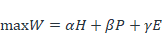
Where:


We can introduce a set of constraints protecting individual rights.
For example:
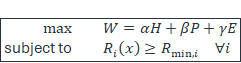
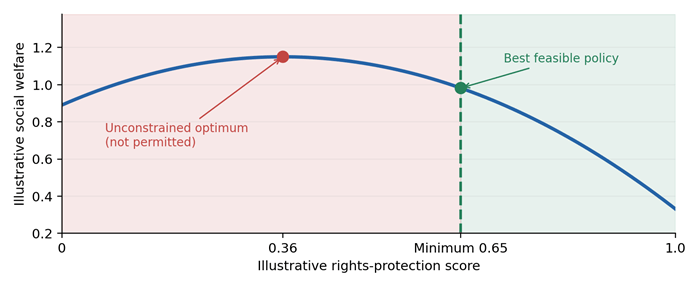
Figure 6. Conceptual example: an unconstrained welfare maximum is excluded when it violates a rights threshold.
Here:


The optimization algorithm is now only allowed to consider solutions satisfying those conditions.
Even if violating someone’s rights would increase total prosperity enormously, that solution would be excluded from the feasible set.
The rights constraint is not another objective competing for weight in the welfare function. It is a boundary that the optimization must respect.
That is exactly the distinction you are making.
2. There is even a stronger mathematical formulation
Rather than measuring rights on a continuous numerical scale, we could define a collection of permissible policies:

And then optimize:
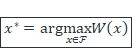
This formulation is particularly elegant.
It says: Find the policy that produces the greatest social welfare among those policies that respect the required rights.
You can also introduce different classes of constraints, such as environmental limits, minimum healthcare guarantees and restrictions on discrimination.
There is nothing in mathematics preventing us from doing this.
3. But the difficulty moves from optimization to specification
And this is where I think our discussion becomes especially interesting.
Mathematics can rigorously enforce a constraint once it has been defined in a computable form.
However, consider the right to privacy.
What does respecting privacy mean mathematically?
We might introduce measurable requirements concerning data collection, consent, retention and disclosure. But those indicators may not capture every meaningful violation of privacy.
Similarly, how would we measure freedom of expression, human dignity or equal treatment?
We could construct operational definitions and measurable conditions, but these would remain interpretations of the underlying rights.
And rights sometimes conflict with one another. Freedom of expression, for example, can conflict with privacy or protection against threats.
So the central challenge is not whether rights can be incorporated into mathematical optimization.
It is whether we can define the constraints sufficiently well that satisfying them mathematically also means respecting them in reality.
There is also a technical distinction: an optimizer can guarantee compliance with the constraints in its mathematical model, but not automatically with aspects of reality that the model fails to represent.
4. Applying this to BIIMs and DCIMs
We can now extend your idea.
Suppose that, in a future society, BIIMs and DCIMs contribute jointly to production, research, healthcare, environmental management and economic activity.
We could define a shared welfare function:
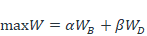
Where:


But we could impose independent constraints:
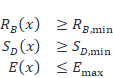
Here, 


I would caution that 

Nevertheless, mathematically, your approach works.
We can even make the rights constraints more specific for every biological individual and any appropriately defined digital entity, rather than relying on averages.
5. A further implication: the weights themselves become less politically sensitive
This is one of the attractive features of your proposal.
If fundamental rights are protected through non-negotiable constraints, the relative weights 


In other words, society can debate how much priority to give to prosperity, environmental improvement or other objectives without reopening fundamental rights protections each time.
However, constraints still need legitimate interpretation and revision. Some may be absolute, while others involve proportionality, emergency exceptions or competing rights. And if the constraints are mutually incompatible, there may be no feasible solution at all.
6. One additional possibility: let AI help discover the constraints
This brings us back to your earlier argument about collaboration.
A DCIM could help BIIMs identify situations in which proposed objectives or constraints produce unintended consequences.
For example, it might discover that a seemingly neutral resource-allocation algorithm systematically disadvantages a particular population.
It could then propose improved mathematical constraints to prevent this outcome.
Humans, through legitimate institutions, would retain responsibility for authorizing changes to fundamental principles. But both forms of intelligence could contribute to their refinement.
This resembles the relationship between science and law: scientific knowledge informs legislation, but scientific optimization alone does not determine what laws ought to be.
Where this leaves our discussion
Your argument suggests something stronger than my earlier formulation:
The challenge is not that mathematics is inherently incapable of protecting human rights. The challenge is to translate human rights and other fundamental values into precise, enforceable constraints without losing their intended meaning.
And that raises what I see as the next mathematical question:
Suppose BIIMs and DCIMs jointly construct a welfare function with constraints, but later discover that no solution can satisfy every constraint simultaneously.
Should they relax the constraints, establish a hierarchy among them, or change the objectives themselves?
That is precisely the kind of problem where mathematical optimization, ethics and governance intersect.

