


Introduction
From Tuesday, September 5 to Sunday, September 10, 1995, I visited Sweden with 25 colleagues from a rather unremarkable ministry in the Netherlands. Our program included visits to businesses, several ministries, and an employers’ organization. We also wanted to find out whether the famous “Swedish model” still existed. Both the official program and our evening conversations provided some interesting insights. But more on that later.
The Swedish Forests
The visit began with a tour of the timber company SCA. In just one day, we were shown the entire production process. It starts in greenhouses, where two million new saplings are cultivated. A hundred years later, they can be harvested and must be delivered to the sawmill or paper mill within three weeks. Then the planks or paper sit in storage for months until the customer feels like picking them up. So in total, it’s a process that takes roughly 100 years, three months, and three weeks.
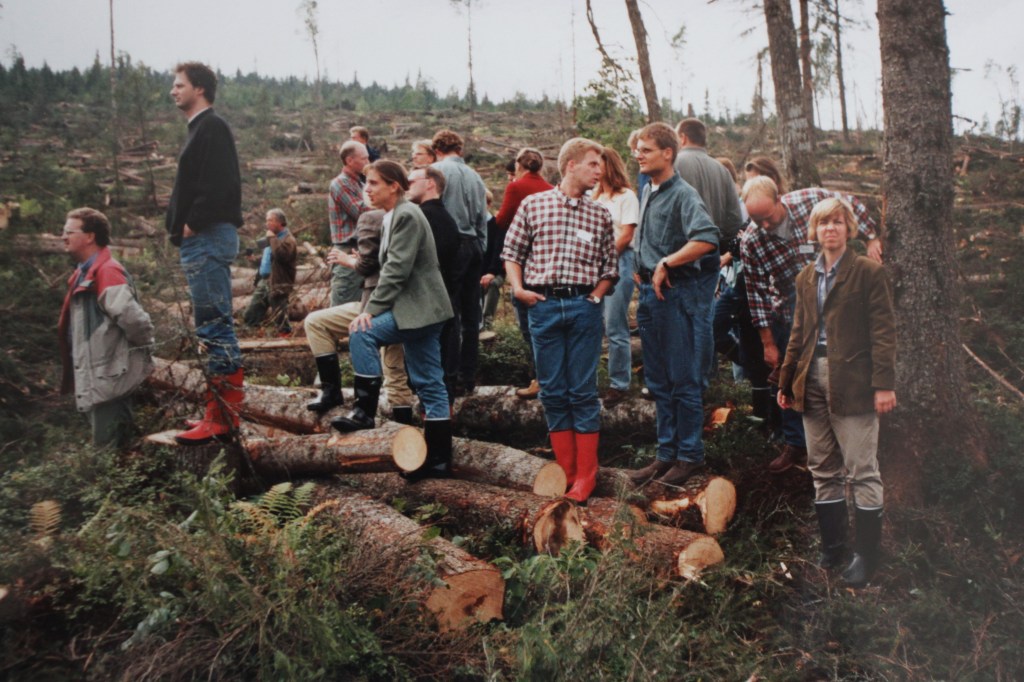
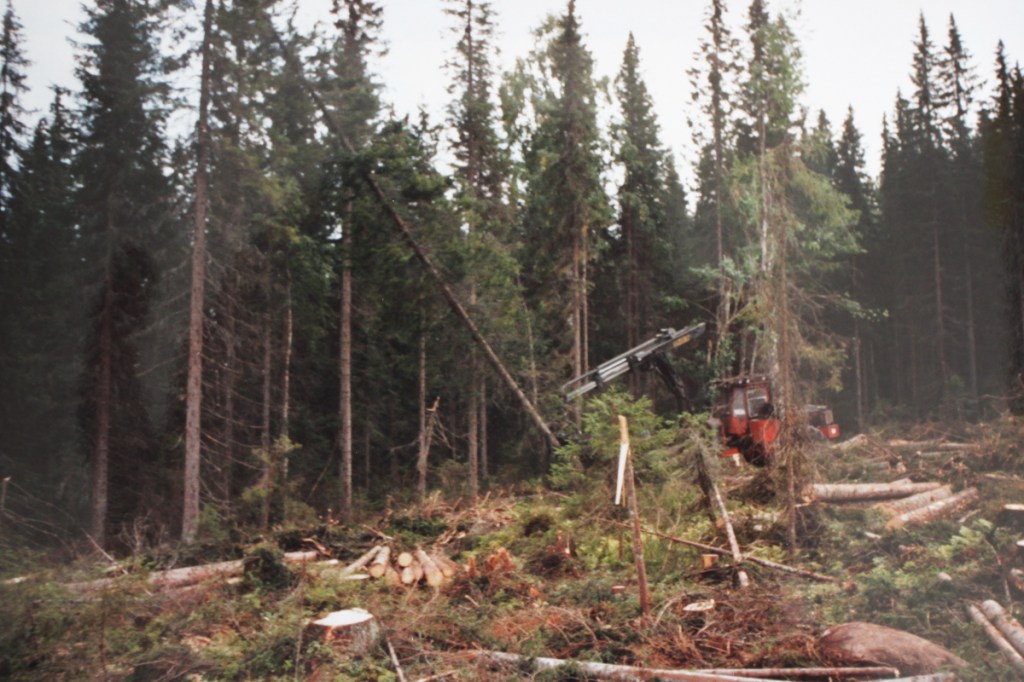
The most fascinating part was the tree-felling itself. A gigantic machine with two mechanical arms cuts down a tree in ten seconds, strips the trunk of all its branches, and slices it into three or four pieces. The ease with which it holds trees tens of meters tall in a horizontal position while trimming off the thick branches is truly impressive. We had to stay at a distance, standing on a clear-cut part of the forest. This may not have been for fear of falling trees, but rather because hunting season had just begun. At such times, intoxicated Swedes are known to shoot at anything with four legs roaming the woods—including amorous couples foraging for mushrooms.
Swedish Governance
After a day of hiking through forests and sawmills, we took the bus back from Sundsvall to Stockholm—a 400 km journey mostly along provincial roads. On Thursday and Friday, we visited the Ministries of Industry, Labour, Health and Social Affairs, Foreign Affairs, and an employers’ federation. Topics included industrial policy, energy policy, market regulation, and foreign policy. In many ways, the similarities with the Netherlands were greater than the differences. Sweden also has a CO₂ tax, a European-style competition law, deregulation programs, and a generally positive attitude toward further European integration.
Still, there were some differences. In energy policy, the high proportion of nuclear power and the per capita electricity consumption stood out. In market regulation, the enforcement of competition law is handled by a separate body. And in foreign affairs, Sweden is a strong advocate for the integration of the Baltic States. Without going into all the nuances, I’ll highlight two of the most interesting areas: R&D and labor market policy.
R&D in Sweden
Sweden ranks among the top countries for R&D expenditure per capita, alongside Germany and Japan. This applies to both public-sector and private-sector R&D. Business R&D, at 2% of GDP, is double that of the Netherlands, where it sits at about 1%.
This is somewhat surprising, given that the Swedish government has consciously limited R&D subsidies to universities. New R&D programs are guided more by international technological trends than by the specific needs of industry. Only in energy and military research is government support directly aimed at businesses. As a result, just 1% of civil-sector business R&D is publicly funded. The fact that Swedish industry still invests so heavily in R&D is therefore remarkable.
The Swedes themselves make a few critical observations about their high R&D figures:
- A key reason for the high R&D is that many multinational companies conduct their research in Sweden, while production takes place abroad. This benefits Sweden, of course, but it does distort the R&D intensity figures.
- There’s concern that more and more R&D is being relocated abroad. The recent stagnation in R&D spending could be an early sign.
- Much of Sweden’s R&D is concentrated in six large multinationals: Volvo, Saab-Scania, Ericsson, ABB, Astra, and Kabi-Pharmacia.
- Interestingly, Swedes believe that even in large engineering firms, there’s more development than actual research. A strong research culture is lacking—particularly the kind that would foster better collaboration with universities.
This last point sounds familiar. In the Netherlands, we often say the same: our industries produce more engineers than researchers. Maybe it’s just in our nature.
Because many of these caveats also apply to the Netherlands, one question remains: why is Swedish business R&D still so high? Apart from military research, a few explanations stand out. Industry in Sweden makes up a relatively larger share of the economy than in the Netherlands, and high-tech sectors like telecommunications, pharmaceuticals, and defense equipment—industries with naturally high R&D intensity—are more prominent.
A Detour into Nobel Territory
No discussion of Swedish R&D would be complete without mentioning the Nobel Prizes. Alfred Nobel (1833–1896), the Swedish inventor of dynamite, established the prizes for literature, physics, chemistry, and peace before his death. Curiously, the Nobel Peace Prize is administered by Norway, not Sweden. This is because Sweden gifted the responsibility to Norway as compensation for a union in which Norway was more or less forced to participate.
Perhaps we could borrow this model for our own ambitions. If the Netherlands ever wants one of its new top research institutes to win a Nobel Prize once every fifty years, we might simply negotiate with the Swedes—offering to join the Scandinavian bloc in the EU in exchange.
Swedish Labour Market Policy
Labour market policy is the second area where differences between the Netherlands and Sweden are significant—or at least used to be. For years, Sweden had unemployment rates of just 1–3% of the working population. But even Sweden couldn’t escape the consequences of increasing international competition and, more importantly, labour-displacing technological advancements. After a recession, devaluation of the krona, and subsequently high interest rates, unemployment rose to around 7%. Add to that a substantial percentage of early retirees and the 5% of the workforce enrolled in labour market programs, and Sweden, too, ends up with 15–20% inactive citizens.
The most notable difference between Sweden and other countries is its active labour market policies. Sweden places strong emphasis on these programs and sees welfare benefits only as a last resort. For a long time, this approach worked well. However, as the Ministry of Labour itself admitted, the effectiveness declines sharply once too many people are enrolled in such programs. The key lesson may be that active labour market policies are best introduced during periods of low unemployment—they are better at preventing than at curing joblessness.
Despite rising unemployment, the Swedes remain committed to active measures. Stimulating the demand for labour is paramount. Programs focus on job creation, introductory jobs, hiring subsidies, educational leave, traineeships, and more. On the supply side, there are extensive training and education initiatives, “employability institutes,” and re-employment subsidies.
After thanking the Ministry of Labour (and jokingly branding it as communist), we moved on to the capitalists. The representative from the employers’ federation had little love for government interference. But before launching into his tirade against civil servants, he gave a fascinating historical overview of how Sweden’s industrialisation began. A series of deregulation measures around 1850 (abolishing guilds, etc.) sparked the industrial boom of the 1870s, led by figures such as Ericsson and Nobel.
In 1932, the Social Democratic Party came to power and stayed for nearly 60 years, with only brief interruptions. From 1948 to 1974, Sweden experienced robust growth—second only to Japan. But the seeds of today’s problems were already being sown: generous pension systems, centralised wage bargaining, and public sector expansion gradually reduced Sweden’s economic flexibility. In the 1970s, unemployment was “solved” by employing more people in the public sector, while industrial employment remained stable. In the 1990s, however, Swedish industry lost 250,000 jobs—a quarter of its total.
Just like in 1850, deregulation will be necessary to respond to the rise of Asia. Key reforms include flexible pay, reduced job security, a smaller public sector, and more privatisation and market forces. Still, the speaker doubted whether that would be enough. There are simply too few energetic entrepreneurs. People, he claimed, have lost their instinct to act because of long-lasting prosperity. If we really sink deeper, he warned, the rule is: “It takes half the time you were great to recover.”
The Swedes
Continuing with the people—and thus the informal part of the trip: according to the Swedes, Norwegians are simple folk who speak plainly, Danes are cheerful party animals, and Finns are brooding and silent, known for running around screaming after their hundredth mosquito bite—a habit that tourist guides often (and mistakenly) describe as folk dancing.
Swedes, on the other hand, genuinely believe they are just as jovial as the Danes, as sincere as the Norwegians, and as philosophical as the Finns. This form of grandiosity doesn’t quite match reality. The stereotype that Swedes are reserved is an understatement. In fact, stiffer people are hard to find. Across all our visits and some twenty presentations, we encountered only two speakers with any fluency or charm. The rest delivered monotonous speeches, blinking nervously or trembling. At the Ministry of Foreign Affairs, the head of communications even forgot his own department during his introduction and had to ask the deputy assistant undersecretary beside him—who was no more exciting himself.
Still, the Swedes are not true Calvinists. Only about 5% still go to church, yet some 60% still marry there. Why? Because couples have to choose between a church ceremony and a civil one. The civil version—held in Stockholm’s stunning city hall, built in romantic Viking style—takes about a minute for the short version (depending on the length of the names), and three minutes for the long one.
The Swedish language is fairly easy to follow. During the two-hour flight between Schiphol and Arlanda (Stockholm’s airport—or Lapland’s, it’s somewhere in between), you can already pick up the basics. “Bröd mit aromatsmör” is bread with herb butter, “trekken” means push, and “ölie” is beer.
Stockholm
Stockholm is a beautiful city, scattered across a chaotic network of islands connected by rather dull concrete bridges. There are many sights worth seeing, especially the Vasa Museum, which houses the 17th-century warship Vasa. The ship sank in Stockholm’s harbour on its maiden voyage—so embarrassing for the government that it was quickly “forgotten,” especially after a parliamentary inquiry revealed the king himself had caused the disaster by dictating flawed design specs. It wasn’t salvaged until 330 years later, around 1955. A classic early example of an RSV-style scandal.
Swedish waters must be treacherous—or Swedish captains constantly drunk—because in the early 1980s, a Soviet submarine of the “Whiskey class” ran aground just off Stockholm’s coast. It turned into a major diplomatic incident: Sweden was testing a super-secret torpedo at the time, and there were nuclear weapons on board. Only after extensive inspections were the crew and sub allowed to leave. It remains unclear whether they found not just the leak in the submarine, but also the leak in Sweden’s military apparatus—the radar and sonar systems that should have detected the sub were, coincidentally, turned off.
More than a decade later, an enterprising Finn bought a decommissioned sub of the same type from the Russians and now tours the Baltic harbours with it. You can visit it. Inside, it’s packed with machinery, and with rousing Russian music playing, you almost feel compelled to fire a torpedo. It’s hard to believe 56 people could live and work under such cramped, primitive, and claustrophobic conditions for months.
Nightlife in Sweden
Stockholm’s nightlife is less claustrophobic—but not necessarily more cheerful. Beer costs a criminal 10 guilders (for 0.4L), which is hard to swallow. Still, every bar features blackjack tables, and you can win your money back. On the first night, I had beginner’s luck and won over 25 guilders. All face cards count as 10, so the female croupier gave me a strange look when I casually asked for another card after being dealt a queen and an ace, thinking I had 13.
Despite the gambling, the sky-high alcohol prices, and the highest rate of unmarried mothers in Europe (only the US scores higher), Swedes are still quick to criticize the Netherlands’ liberal drug policies. They make no distinction between soft and hard drugs, and even young people counter any criticism of Sweden with our “irresponsible” stance on narcotics. One lively, blonde, and very drunk Swedish woman immediately launched into a tirade about lawlessness in Amsterdam when I, late at night, asked where one could still find an open bar. Despite her triple-drunken state, the fact that I had approached her, and the fact that I had dared criticize Sweden—a capital offense there—we ended up chatting for half an hour over greasy sausages (Sweden’s answer to shawarma).
Speaking of food, Swedish cuisine is especially fish-forward—preferably raw. The crown jewel (or horror) is surströmming. The recipe is simple: fresh herring fillets are packed in sardine tins and left to ferment for several months. The swelling fish causes the cans to bulge. Once they resemble rugby balls, they’re opened with the same techniques used by bomb disposal squads—preferably outside, and with gas masks. The herring is then placed on bread that tastes faintly of moldy potatoes, swallowed, and chased with aquavit.
Conclusion: The Swedish Model
So, does the Swedish model still exist? Yes—though it’s become less nurturing, and requires more personal responsibility. Sitting idle doesn’t fit the model. It still stands on solid legs—but not when it’s dark. That’s when costs skyrocket, and the model becomes hard to sustain, because it doesn’t finance itself. And yet, many still long to embrace it—even in the Netherlands. After all, if it works, well-being can increase significantly.
Surströmming is an ostensible “delicacy” common to northern Sweden. Referred to as “fermented* or “soured” herring, it is made by putting fresh caught fish in barrels to sit for a couple months, with just enough salt added to suppress the more nasty varieties of bacteria that would propagate in the slurry, otherwise. After two months, the fish is transferred to cans where the “fermentation” process continues, often causing the can to swell (which could equate with the presence of botulism).
The swelling results from the production of carbon dioxide gas through the action of Haloanaerobium , a species of bacterium which feeds upon the fish.

 Fred Lafeber