

We entered Serbia at the border near Szeged, a small Hungarian town famous for its Pick salami—a brand in which I’ve held shares for about ten years now. Pick eventually acquired Hungary’s other iconic salami brand, Hertz, effectively becoming a private monopoly in the country’s meat industry. Naturally, we paid a visit to the factory to pick up the annual report and were pleased to learn that the company remained financially sound. The slicing trend in its share price must have had other causes. I remain convinced that Pick Szeged stock was once a solid investment tip—though in reality, it never paid off and was delisted from the Budapest Stock Exchange around 2004.
Speaking of investments, insurance companies in Serbia could be another one to watch. Despite what our green card (international car insurance) stated, we learned firsthand that Yugoslavia, in some form, still exists. At the border, we were told we needed to buy additional coverage for €80. Our protests—that our insurance company had assured us Yugoslavia no longer existed and that Serbia was covered—were quickly brushed aside. In hindsight, it was probably the most foolish thing I could have said when entering proud Yugoslavia, now consisting of Serbia, Montenegro, and the autonomous province of Vojvodina (which is part of Serbia). Fortunately, our contribution to the country’s foreign exchange reserves was accepted with grace by the customs officials. Later, at the toll booths, we had to pay in euros despite having just exchanged dinars. When I asked why, a not-so-friendly toll officer shrugged: “Strangers pay euro, dollar, valuta.”
The roads in Serbia are surprisingly empty—perhaps due to the tolls—but that doesn’t mean they’re safe. There are two main lanes and a so-called emergency lane, which locals use as the default lane for driving below 150 km/h. The center lane is for overtaking in both directions, a setup that leads to frequent and dangerous misunderstandings. On either side of the main road, muddy tracks serve as local access routes.
From the border, it took just an hour to reach Novi Sad, the city heavily bombed by NATO during the Kosovo War in May 1999. We were in a rush and slightly anxious about driving a Dutch-registered car through the city. The atmosphere felt a bit tense, although a kind old lady in a shop was delighted to see “guests from Holland.” We moved on quickly and missed seeing the bombed bridges.
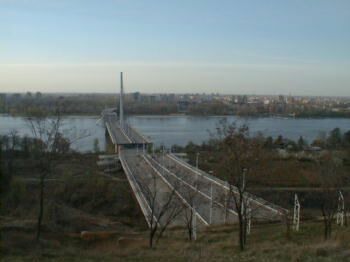
Two days later, we returned and had the chance to photograph one of the destroyed bridges, still partly collapsed into the river—a haunting sight on a sunny Sunday from the hilltop citadel of Novi Sad. The Serbs have yet to repair all the bridges, citing financial limitations—and perhaps also hoping that the other Danube countries, eager for uninterrupted river navigation, will push the West to assist. A new pontoon bridge that opens for ships only every few days reinforces the urgency. Assistance will likely come, if only to clear the wreckage.
But we hadn’t yet reached Belgrade—the “White City”—and we wanted to arrive at our guesthouse before dark. We continued down the three-lane “highway.” The outskirts of Belgrade looked promising, with some newly built apartment blocks, but soon the familiar grey socialist flats reappeared—just like in Chemnitz, Brno, Bratislava, Prague, and Budapest—still evoking memories of communist Eastern Europe.
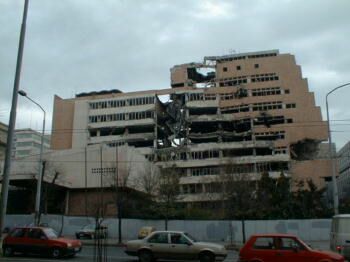
Turning off toward the Sava Center, we had our first real encounter with the war’s scars: the bombed-out headquarters of the Socialist Party. All the windows were gone, yet unlike New York’s Twin Towers, the building still stood—barely. We made our way into the city center, deciphering street signs written entirely in Cyrillic.
The next day we began exploring Belgrade, starting at the old Kalemegdan citadel, perched where the Danube and Sava rivers meet (we would later see the source of the Sava in the Slovenian mountains, in Bohinj). Although much of the fortress dates to the 17th century, the site has been fortified since Celtic times. The original settlement, Singidunum, was founded in the 3rd century BC. The Romans arrived in the 1st century AD and stayed until the 5th. The present-day name, Beograd, first appeared in a papal letter from 878. The city became Serbia’s capital in 1403, was taken by the Turks in 1521, and regained its capital status in 1842—and again in 1918, as the capital of Yugoslavia.
Today, Belgrade feels like a city at a crossroads, undecided about its future. Some areas feature sleek, modern shopping streets with well-stocked stores; others are cluttered with flea markets and survival-style retail. While cities like Prague, Budapest, and Bratislava have flourished, Belgrade still bears the scars of a decade-long war economy and sanctions.
The most striking sights are not the tourist attractions—there aren’t many—but the bombed-out shells of the Ministry of Defence and the Ministry of Interior. You can see precisely where the rockets hit: gaping holes, sagging concrete, the raw impact of precision munitions. That nearby residential blocks suffered so little damage borders on miraculous. A surreal touch: a bright McDonald’s billboard stands proudly in front of the ruins of Serbian intelligence headquarters.
After absorbing so much sorrow, we needed an evening to unwind. Fortunately, Belgrade has a vibrant nightlife. Bars buzz with energy, and the terraces are full in summer. Disco boats drift along the river late into the night. It feels as if the youth of Serbia are dancing off the past, much like Europe did in the 1920s after World War I. But it’s not all joy—groups of skinheads in leather jackets add an undercurrent of tension. Perhaps they are the same young men who once fought in those wars, now in their 20s and 30s?
We left Belgrade with many questions unresolved, heading along the new highway before detouring onto secondary roads toward the border with Croatia. Our goal: to witness the war damage in Vukovar. The crossing was small and the contrast between the two sides was stark. On the Serbian side stood an old concrete shack with a wood-burning stove, a rusty manual gate, and no shelter from the rain. Just 100 meters away, the Croatian side had a brand-new border station. The difference felt almost symbolic—perhaps even intentional, like the unrepaired ministries in Belgrade or the broken bridges of Novi Sad.
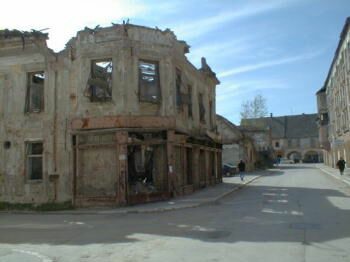
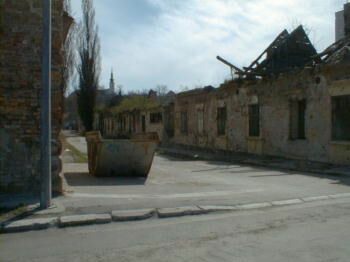
As we approached Vukovar, it became clear that the Croats, too, had not yet repaired everything. This was a war zone in 1991–1992, where heavy fighting erupted after Croatia declared independence. At first, Serbian forces occupied a third of the country. A UN-brokered ceasefire led to a partial withdrawal, but the Serb minority in the Krajina region declared independence—which Croatia eventually reclaimed. Along the road, we saw bullet-riddled signs, pockmarked houses, minefields, and collapsed electricity pylons. On Vukovar’s outskirts, private homes had been rebuilt, but the town center looked as if the war had ended only yesterday. Words can’t do it justice—the pictures we took say more than I ever could.
We left Vukovar with a deeper understanding of what really happened in Yugoslavia during the 1990s. Slobodan Milošević should be held accountable not only for his crimes in Kosovo and Bosnia—places we didn’t yet dare to visit—but also for the atrocities in Croatia, and even against his own people: the civilians living near bombed ministries, terrified during the attacks, whose incomes for a decade followed the same bleak trajectory as my salami shares.
Let’s not play the Balkan blues again.
 Fred Lafeber