
Belfast
In early September 1994, Ireland was shaken by two historic events. First, I visited Dublin with a group of civil servants from some random Dutch ministry. Second, the IRA unilaterally declared a ceasefire. After 25 violent years that had tarnished Europe’s image, there was finally a glimpse of lasting peace.
It would be naïve to view these two events as unrelated. That’s why, on the morning of Saturday, September 3, I drove a rental car—initially on the right side of the road but very quickly switching to the left—out of Dublin and toward the capital of Northern Ireland, Belfast. The group had assigned me the task of investigating whether the visit by the Ministry of Economic Affairs had in fact led to the laying down of arms. Or, more broadly: is there a link between economic policy and political violence? Although a dangerous mission, a drunken waiter at Guinness had assured me during a company visit that it was perfectly safe.
At the border, a large sign with red letters reads “RAMP” (mening disaster in Dutch. Convinced I shouldn’t slow down in a disaster zone, I press the gas—only to find out in fourth gear that “ramp” means speed bump. The next obstacle is a row of iron spikes jutting menacingly from the road. I hesitate to drive over them, but the cars behind me urge me on. Risking four flat tires, I edge forward—thankfully, the spikes give way. A soldier at the border waves me through. Clearly, someone this clueless can’t be a terrorist.
Upon arriving in Belfast, I look for parking. It’s not allowed in the city center due to the threat of car bombs, so I find a spot in a suburb. Without thinking, I park my Irish, Catholic-looking car in front of what’s likely a Protestant family’s home—Belfast, after all, is a Protestant stronghold—and walk toward the city.
The city center surprises me with its beauty. I hadn’t expected that. Belfast is often portrayed as a gloomy city full of soldiers, grey suburbs, and a war-torn downtown. But what I see are countless historic buildings, a beautiful white city hall, a stately opera house, a classical university, a botanical garden, and a vibrant shopping district. The city is surrounded by high hills and the sea, and the River Lagan flows through it, emptying into the Irish Sea via the harbor. I wander through the city, browse the shops, and enjoy coffee and cake. A pity it’s raining.
From a documentary shown on Dutch television before our trip, I had gotten the impression that Belfast was teeming with snipers and paramilitary groups. But today, at least, that’s not the case. Cheerful people are out shopping on this Saturday afternoon. There are few soldiers on the streets. Is it the ceasefire? Or just the rain? On the main street, I witness the start of the first Belfast to Dublin Peace Run—a relay for peace. The runners still look fresh.
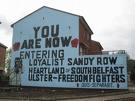
Of course, it would be misleading to paint an overly rosy picture of Belfast. Some streets are cordoned off due to security measures. Signs everywhere forbid public drinking in the city center. And the impoverished suburbs—where most of the violence takes place—remain out of sight. One Protestant church is draped in British flags, making a clear statement.
Tourism hasn’t quite taken off yet. According to the visitor log at the tourist office, I’m the tenth tourist this week. Still, Belfast has everything it needs to become a major tourist destination. Northern Ireland’s nature and coastline are stunning. I realize this as I return via Silent Valley in the Mourne Mountains to the south. For ten kilometers, all I see are golden gorse and purple heather growing against the steep slopes of the valley. I don’t encounter another car, and the silence is profound. What a contrast to the tension and bustle of Belfast.
Near the border, I pass the peace runners again. They’re drenched and scattered. Some are no longer even running. Their wet singlets give them a somewhat shabby appearance. I hope this isn’t symbolic of the peace process. Almost as exhausted as the runners, I return to Dublin twelve hours later.
The very next day, the fragility of the peace process becomes clear. A bomb attack on Sinn Fein’s headquarters shows that radical Protestants have no intention of disarming just yet. Later in the week, Reverend Ian Paisley is even thrown out of John Major’s office. But on the way to the airport in Dublin, I see the peace runners again. They made it after all.
 Fred Lafeber